
Quick answer
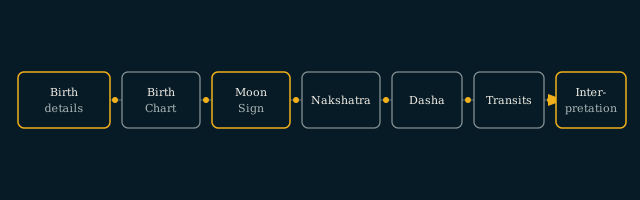
Vedic astrology (Jyotisha) interprets the sky at birth using the sidereal zodiac. A chart is built from date, time and place, then read in layers: planets, signs, houses, Moon Sign, Nakshatra, Dasha periods and transits. No single factor replaces the whole chart. Moon Sign’s educational guides follow that layered approach.
New to Vedic Astrology?
Start with:
- Vedic Astrology (this page)
- Birth Chart
- Moon Sign
- Nakshatra
- Lagna
- Dasha
- Transits
Key takeaways
- Vedic astrology is traditionally sidereal and chart-based.
- Birth date, time and place locate the sky for calculation.
- Moon Sign, Nakshatra, Lagna, Dasha and transits are complementary layers.
- Ayanamsa bridges tropical longitudes to the sidereal frame; Moon Sign methodology uses Lahiri.
- General horoscopes are not the same as birth-chart interpretation.
- Use the glossary when a term is unfamiliar.
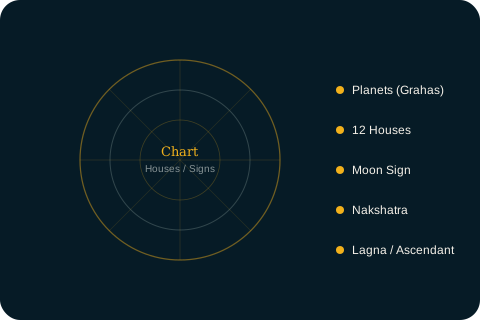
In Vedic astrology, a person’s chart is treated as a map of planetary positions for a specific birth date, time and place. Rather than relying on a single sign alone, traditional interpretation looks at how several layers interact: planets (grahas), signs, houses, the Moon Sign, Nakshatra, planetary periods (Dasha) and later movements known as transits.
Moon Sign is building a modern experience around these classical ideas, so understanding the system helps you read each topic in context.
What Vedic astrology is
Vedic astrology is rooted in Indian astronomical and interpretive traditions. It commonly uses the sidereal zodiac, which is aligned with the fixed stars, rather than the tropical zodiac used in most Western Sun-sign horoscopes. Because of that difference, planetary sign placements in a Vedic chart may not match popular tropical Sun-sign columns.
Jyotisha traditionally aims to describe temperament, timing themes and life areas through calculation and interpretation, not as guaranteed predictions. Astrologers may consider the chart as a symbolic language for reflection and guidance.
Lahiri Ayanamsa (confirmed methodology)
Ayanamsa is the angular offset used to convert tropical planetary longitudes into the sidereal frame. Different Ayanamsa conventions exist. Moon Sign’s confirmed calculation methodology uses Lahiri Ayanamsa for sidereal placements such as Moon Sign, Nakshatra and related chart factors. This page explains the idea at a high level; it does not publish proprietary formulas. For product direction, see how Moon Sign works.
Birth date, time and place
Three pieces of information form the foundation of a Vedic birth chart:
- Date of birth: establishes the calendar day and the broader planetary backdrop.
- Time of birth: needed for the Ascendant (Lagna), house cusps and fine Moon/Nakshatra detail.
- Place of birth: provides geographic coordinates and local timezone context used to reconstruct the sky. See also birthplace and timezone.
When birth time is unknown or approximate, some parts of the chart become less reliable. See why birth time matters.
Planetary positions
Classical Vedic practice focuses on the Sun, Moon, Mars, Mercury, Jupiter, Venus, Saturn, Rahu and Ketu. Each planet is interpreted through its sign, house placement, relationships with other planets and condition in the chart. The Moon often receives special attention because it is associated with mind, emotion and daily lived experience. For the lunar nodes specifically, see Rahu and Ketu.
Houses and signs
The twelve houses describe areas of life such as self, resources, communication, home, relationships and vocation. Signs describe the style or quality through which planets express themselves. The Ascendant (the sign rising on the eastern horizon at birth) is traditionally central for house structure when birth time is known.
Moon Sign
Your Moon Sign is the zodiac sign occupied by the Moon at birth. In Vedic astrology it is frequently treated as a key marker of emotional patterns, instincts and inner responsiveness. It is important, but it is still one layer of a larger chart.
Nakshatra
Nakshatras are 27 lunar mansions that divide the zodiac more finely than the twelve signs. The Moon’s Nakshatra at birth adds qualitative detail and is also used in determining Vimshottari Dasha starting points.
Dasha: planetary periods
Vimshottari Dasha describes planetary periods that unfold over time. Mahadasha and Antardasha sequences are traditionally used to understand which planetary themes may become more prominent during different life chapters. Periods are interpreted with the full chart, not as standalone guarantees. For how periods relate to current sky movement, see Dasha vs transits.
Planetary transits
Transits track where planets are moving now relative to the natal chart. They are often used for shorter-term context, while Dasha describes longer timing chapters. Both are most meaningful when read against the birth chart rather than in isolation.
How the parts work together
A useful way to think about Vedic astrology is layered reading:
- Birth details locate the sky.
- Planets, signs and houses form the chart structure.
- Moon Sign and Nakshatra describe inner and lunar themes.
- Dasha frames longer life periods.
- Transits describe current activations of natal points.
No single layer replaces the others. A complete birth chart reading keeps these pieces in conversation.
General horoscopes vs birth-chart interpretation
General daily or sign-based horoscopes speak to broad audiences. Birth-chart-based interpretation uses individual birth data and is therefore more personal, but also more dependent on accurate details. Moon Sign aims to present chart-based Vedic astrology in clear language, with human astrologer guidance planned for deeper questions.
Common misconceptions
- Vedic astrology is not the same as tropical Sun-sign columns.
- Knowing one placement (Moon Sign or Sun Sign) is not a full chart reading.
- Dasha periods are not automatic guarantees of specific events.
- Sidereal placements can differ from familiar Western labels for the same birth.
Important: Astrology content on Moon Sign is interpretive and educational. It is not a substitute for medical, legal, financial or mental-health advice. Read our Astrology Disclaimer.
Frequently asked questions
Is Vedic astrology the same as Western astrology?
They share planetary language but often differ in zodiac frame, emphasis and techniques. Vedic practice commonly uses the sidereal zodiac and gives strong weight to lunar factors and Dasha timing.
What is Ayanamsa?
Ayanamsa is the offset used for sidereal calculation. Moon Sign methodology uses Lahiri Ayanamsa.
Do I need exact birth time?
Exact time improves Lagna, houses and some lunar boundary work. Approximate or unknown time still allows cautious planet-in-sign discussion with clear limits.
Where should a beginner start?
Follow the Start here path on this page, then use the glossary for definitions.
What is the difference between Dasha and transits?
Dasha is a natal period sequence; transits are current planetary movement. See Dasha vs transits.
Does this website calculate my chart?
No. These pages are educational. Calculation features are product direction for the Moon Sign app. See how Moon Sign works.