
Quick answer
In Vedic astrology, Lagna (also called the Ascendant) is the zodiac sign rising on the eastern horizon at the moment of birth. Astrologers traditionally use it to structure the twelve houses and to understand how a person meets the world. Because the rising sign changes through the day, accurate birth time and place matter for a reliable Lagna.
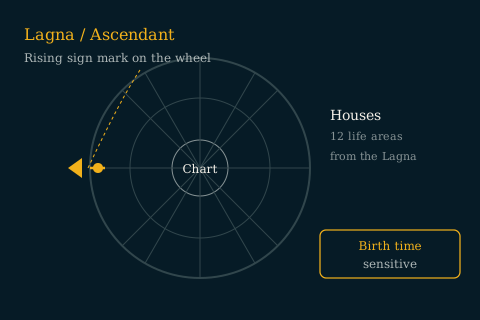
Key takeaways
- Lagna means Ascendant: the rising sign at birth.
- It traditionally anchors house organization in many Vedic readings.
- Lagna changes roughly every two hours as the Earth rotates.
- Moon Sign and Lagna describe different layers of the chart.
- Unknown birth time limits confident Lagna and house claims.
- Lagna is read with planets, signs and the full chart, not alone.
Lagna and Ascendant meaning
Within a Vedic astrology framework, Lagna is the sign occupying the eastern horizon at birth. It is often treated as a key reference point for how life areas (houses or bhavas) are arranged. See the broader birth chart guide for how Lagna sits among other chart layers.
Relationship to birth time
Because the Ascendant moves through the zodiac during the day, even modest timing differences can change Lagna near sign boundaries. That is one reason birth time and birthplace and timezone are discussed carefully in Vedic practice.
How Lagna changes
As Earth rotates, a new sign rises roughly every two hours, with exact duration depending on latitude and season. People born on the same calendar day can therefore have different Lagnas if their birth times differ.
Connection with houses
In many classical approaches, the first house begins at the Lagna. The remaining houses follow in sequence and describe life themes such as resources, communication, home, relationships and vocation. Explore the overview of twelve houses in Vedic astrology.
Moon Sign vs Lagna
Your Moon Sign describes where the Moon was placed at birth and is often linked with emotional patterns. Lagna describes the rising sign and is often linked with orientation, body and how experience begins. Both are important; neither replaces the full chart.
Limits when birth time is unknown
If birth time is missing or approximate, Lagna and house cusps become uncertain. Ethical interpretation then narrows claims instead of inventing precision. Planet-in-sign themes may still be discussed with more caution around house-based statements.
Common misconceptions
- Lagna is not the same as Moon Sign or Sun Sign.
- Knowing only the birth date is usually not enough for a firm Lagna.
- Lagna alone does not describe an entire personality or destiny.
Fictional comparison
Two fictional people born on the same date in the same city, but several hours apart, may share many planet-in-sign placements while having different Lagnas. Their house structures could therefore differ even though their Moon Sign looks similar.
Frequently asked questions
Is Lagna the same as Ascendant?
Yes. In Vedic astrology, Lagna is the common Sanskrit term for the Ascendant, the rising sign at birth.
How often does Lagna change?
Roughly every two hours on average, though exact timing depends on location and season.
Does Lagna require exact birth time?
Reliable Lagna usually needs accurate time and place. Near sign boundaries, even small errors can matter.
What if my birth time is unknown?
House and Lagna statements should be treated cautiously. Broader planet and Moon themes may still be useful with clear limits stated.
Is Lagna more important than Moon Sign?
They serve different roles. Many Vedic readings give weight to both, alongside the rest of the chart.
Educational only: This page explains concepts. Moon Sign does not calculate Lagna on this static website.