
Quick answer
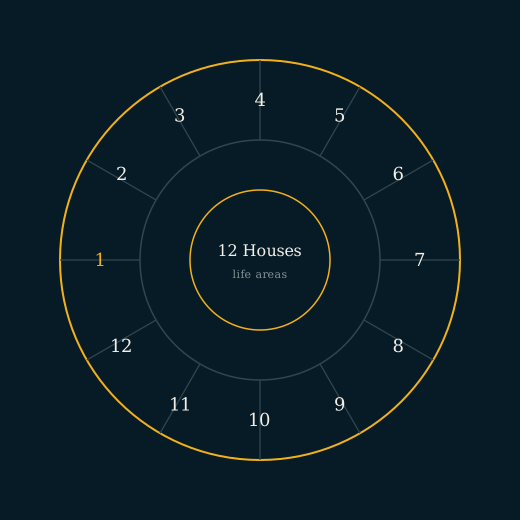
In Vedic astrology, the twelve houses (bhavas) describe areas of life such as self, resources, home, relationships and vocation. House meanings are traditional starting points. Actual interpretation depends on which planets occupy or influence a house, the signs involved, and the wider chart.
Key takeaways
- Houses map life areas, not single guaranteed outcomes.
- Lagna often helps organize which sign sits in the first house.
- Planets activate and color house themes.
- Accurate birth time improves house confidence.
- House keywords are starting points, not complete readings.
- Always read houses with the full chart.
How houses relate to Lagna
In many Vedic approaches, the first house begins at the Lagna. The remaining houses follow in order. That is why birth time matters for house structure. Learn more in the birth chart guide.
Overview of the twelve houses
The summaries below are broad traditional themes. Astrologers may weigh additional techniques, dignity, aspects and timing before offering guidance.
1st House
Self, body, beginnings and overall orientation. Often linked with the Ascendant.
2nd House
Resources, speech, early family themes and values.
3rd House
Courage, effort, siblings, short journeys and skills.
4th House
Home, emotional foundations, mother themes and inner security.
5th House
Creativity, intelligence, romance themes and speculative risk.
6th House
Work routines, competition, service and challenges that require discipline.
7th House
Partnerships, marriage themes and one-to-one agreements.
8th House
Transformation, shared resources, occult research and deep change.
9th House
Higher learning, belief systems, mentors and long-range meaning.
10th House
Public role, vocation, reputation and visible contribution.
11th House
Gains, networks, aspirations and collective belonging.
12th House
Release, solitude, foreign contexts and unseen costs or rest.
House interpretation also depends on planetary periods and current movement. See Vimshottari Dasha and planetary transits.
Common misconceptions
- A house keyword is not a fixed prediction for every person.
- An empty house is not automatically inactive or meaningless.
- House meanings should not be read without chart context.
Frequently asked questions
What is a bhava?
Bhava is the Sanskrit term commonly used for a house in the birth chart.
Do all charts use the same house meanings?
Core themes are widely shared, but schools and techniques can differ in emphasis and calculation details.
Why does birth time affect houses?
Because house structure is often anchored to the Ascendant, which moves with time and place.
Can one house describe my whole life?
No. Charts are traditionally read as interacting systems across all twelve houses and multiple planetary factors.
Reminder: These themes are educational. They are not deterministic forecasts.