
Quick answer
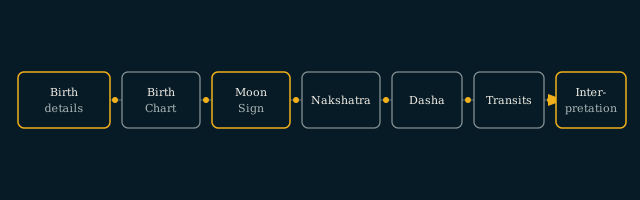
A Vedic birth chart (Kundli) is a map of planetary positions for your birth date, time and place. It organizes planets, signs, houses, Lagna, Moon Sign, Nakshatra and timing systems such as Dasha. Charts are traditionally read as a whole, not as one isolated label.
Key takeaways
- A birth chart is a calculated sky snapshot, not a daily horoscope column.
- Date, time and place unlock different levels of chart confidence.
- Lagna and houses are especially time-sensitive.
- Moon Sign and Nakshatra describe important lunar layers.
- Dasha and transits add timing context to the natal map.
- Isolating one planet or sign can mislead; patterns across the chart matter.
In Vedic astrology, the birth chart (often called a Kundli or Janma Kundali) is the foundation for personal interpretation. It is not a daily horoscope column. It is a calculated snapshot of the sky reconstructed from birth details.
What a Vedic birth chart represents
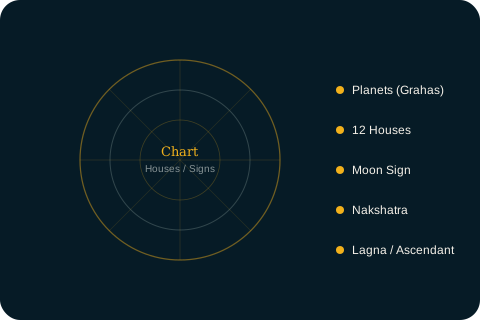
The chart organizes several related pieces of information:
- where each planet was placed
- which signs those placements occupied
- how the twelve houses were arranged
- lunar factors such as Moon Sign and Nakshatra
- timing frameworks such as Dasha
For a broader system overview, see Vedic astrology explained.
Planets (grahas)
Classical Vedic interpretation focuses on the Sun, Moon, Mars, Mercury, Jupiter, Venus, Saturn, Rahu and Ketu. Each is assessed by sign, house, dignity, relationships and overall chart context. Learn more about the lunar nodes in Rahu and Ketu.
Houses
Houses describe life areas. Exact house cusps and Ascendant-dependent structure rely on accurate birth time. Without reliable timing, house-based claims should be treated cautiously. See the overview of twelve houses in Vedic astrology.
Signs
Signs describe qualitative expression. In Vedic practice these are commonly sidereal. That is one reason Vedic placements can differ from tropical Sun-sign expectations.
Ascendant / Lagna
The Ascendant is the sign rising at birth. It traditionally anchors the house system and is among the most time-sensitive chart factors. Read the dedicated Lagna guide, and see why birth time matters.
Moon Sign and Nakshatra
The Moon Sign and Nakshatra describe important lunar themes and help connect the chart to emotional patterning and Dasha timing.
Dasha
Vimshottari Dasha overlays planetary periods onto the natal map, offering a way to discuss changing life chapters over time. Compare period timing with current-sky movement in Dasha vs transits.
Why charts are interpreted as a whole
Isolating one planet or one sign can create misleading conclusions. Traditional practice looks for patterns across multiple indicators: planetary strength, house context, lunar detail and timing. A planet that looks challenging in one area may be supported elsewhere; a promising yoga may still require Dasha activation before it becomes experientially prominent.
Transits are later read against this natal foundation; see planetary transits. Moon Sign’s product direction is to present these layers in a readable order rather than as disconnected technical fragments.
What accurate birth information changes
Date of birth supports broad planet-in-sign statements. Time and place unlock Ascendant, houses and finer lunar boundary work. If timing is uncertain, ethical interpretation narrows claims instead of inventing precision. That principle is central to how Moon Sign discusses chart confidence. Place and zone context are covered in birthplace and timezone.
Common misconceptions
- A birth chart is not a single Sun Sign or Moon Sign label.
- Unknown birth time does not justify inventing a precise Lagna.
- One strong yoga or transit does not override the whole chart.
- Chart software visuals on marketing pages are not live personal calculations on this site.
Fictional whole-chart layers
A fictional chart might show a Cancer Lagna, a Leo Moon in Uttara Phalguni, and several planets distributed across houses. An astrologer would still weigh planetary condition, house rulerships and current Dasha before discussing themes. The example is illustrative only and is not a reading for any real person.
Presentation only: Moon Sign does not calculate live birth charts on this website. Chart visuals here are educational illustrations.
Frequently asked questions
What is a Vedic birth chart?
It is a calculated map of planetary positions for a birth date, time and place, organized through signs, houses and related Vedic factors.
Why do Lagna and houses need birth time?
The rising sign changes through the day. Without reliable timing, Ascendant and house structure become uncertain.
How do Moon Sign and the chart relate?
Moon Sign is one lunar layer inside the chart. It is read with Nakshatra, Lagna, planets and timing systems.
What if my birth time is approximate?
Use cautious interpretation: broader planet-in-sign themes may still help, while house-specific claims should be limited.
Are Dasha and transits part of the birth chart?
The natal chart is the foundation. Dasha unfolds from natal data over time; transits compare the current sky with that natal map.
Where can I look up Vedic terms?
Use the glossary for concise definitions.