
Quick answer
Vimshottari Dasha is a widely used Vedic timing system that divides life into planetary periods. It is traditionally linked to the Moon’s Nakshatra at birth. Mahadasha names longer chapters; Antardasha names sub-periods within them. Periods are interpreted with the full chart, not as guaranteed outcomes.
Key takeaways
- Dasha describes planetary periods rooted in the natal chart.
- Vimshottari is one of the most common personal timing systems.
- Mahadasha is the major period; Antardasha is a sub-period.
- Moon’s birth Nakshatra helps determine the starting sequence.
- The same period can mean different things in different charts.
- Dasha is not the same as a transit; both may be considered together.
In Vedic astrology, Dasha systems describe sequences of planetary periods. Among them, Vimshottari Dasha is one of the most commonly used for personal chart timing.
Responsible interpretation treats Dasha as a way to discuss which planetary themes may become more prominent, not as a guarantee of specific outcomes such as wealth, marriage or loss.
What Dasha means
Dasha refers to a planetary period. Different dasha systems exist; Vimshottari is a major practical standard in many contemporary Vedic contexts.
What Vimshottari Dasha is
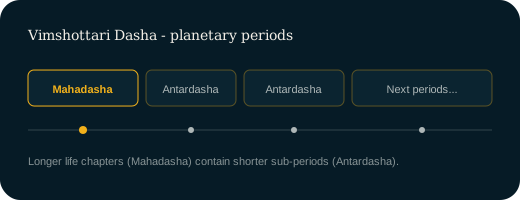
Vimshottari organizes a long cycle of planetary lordships. Each planet rules a Mahadasha of a defined length, and those larger periods contain shorter sub-periods. Period lords can include the classical grahas as well as Rahu and Ketu.
Mahadasha
Mahadasha is the major planetary period. Astrologers may consider it when discussing broader life chapters, developmental themes or sustained areas of focus. The natal condition of the Mahadasha lord strongly affects how the period is interpreted.
Antardasha
Antardasha (also called Bhukti in some usages) is a sub-period within the Mahadasha. The interplay between Mahadasha and Antardasha lords is often used for more specific timing discussions.
Conceptual relationship with Nakshatra
In Vimshottari practice, the Moon’s birth Nakshatra helps determine the starting point of the dasha sequence. This is one reason lunar precision matters for timing work.
Why planetary periods are used
A natal chart describes structure. Dasha describes unfolding. Together they help practitioners discuss when certain natal potentials may become more active in lived experience.
Why Dasha depends on the full chart
The same planetary period can be interpreted differently depending on house rulerships, planetary strength, yogas and overall chart balance. Dasha never stands alone. Context from the birth chart and later transits remains essential. For a direct comparison, see Dasha vs transits.
For example, a Jupiter period may be discussed in terms of growth, learning or opportunity in some charts, while in another chart the same planet’s house rulerships and condition may point interpretation toward different life areas. The period names the planet; the chart explains the terrain.
How to read Dasha responsibly
Useful Dasha study usually asks: Which planet is active? What does that planet rule and occupy in this chart? What supporting or conflicting factors exist? Which current transits reinforce or complicate the period? That sequence keeps timing grounded and reduces formulaic predictions.
Common misconceptions
- A Mahadasha does not guarantee one fixed life result.
- Dasha is not the same as a transit.
- Period names alone are not enough without natal chart context.
- Rahu or Ketu periods are not automatically “bad” or “good.”
Fictional Mahadasha and Antardasha
A fictional person may be described as being in a Rahu Mahadasha with a Venus Antardasha. Those labels name timing layers only. An astrologer would still examine where Rahu and Venus sit, what they rule, how they relate to the Moon and Lagna, and what current transits are doing. This example is not a prediction.
Responsible language: Dasha interpretation is symbolic and probabilistic in tone. It should not be used for absolute claims about money, health, legal outcomes or destiny.
Frequently asked questions
What is Vimshottari Dasha?
It is a widely used Vedic system of planetary periods traditionally linked to the Moon’s birth Nakshatra.
What is the difference between Mahadasha and Antardasha?
Mahadasha is the major planetary chapter; Antardasha is a sub-period inside that chapter.
Is Dasha the same as a transit?
No. Dasha is a natal period sequence. Transits are current planetary movement. See Dasha vs transits.
Why does birth Nakshatra matter?
In Vimshottari practice it helps determine where the period sequence begins.
Can Rahu or Ketu rule a Dasha?
Yes. The lunar nodes participate in Vimshottari sequences. Explore Rahu and Ketu.
Should I read Dasha without the birth chart?
No. Responsible interpretation always returns to natal condition, houses and overall chart balance.