
Quick answer
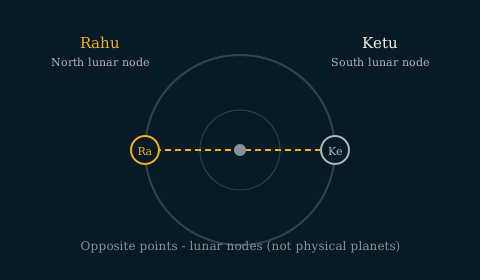
In Vedic astrology, Rahu and Ketu represent the lunar nodes: mathematical points where the Moon path intersects the ecliptic. They form an axis in the chart and are interpreted through sign, house, aspects and period context. They are not treated as ordinary physical planets.
Key takeaways
- Rahu and Ketu are lunar nodes, not solid planets.
- They usually sit opposite each other as an axis.
- House and sign context changes their expression.
- They can participate in Vimshottari Dasha.
- Eclipse astronomy relates to nodes at a high level.
- Node themes should not be read in isolation.
Rahu
Traditionally, Rahu is associated with desire, amplification, unconventional paths and intense focus. Exact themes depend on placement and the rest of the chart.
Ketu
Traditionally, Ketu is associated with detachment, specialization, past-pattern release and inward refinement. Again, chart context decides how those themes are discussed.
The nodal axis
Because Rahu and Ketu are opposite, they are often read as a paired axis: two poles of experience that need balance rather than one isolated label.
Eclipses at a high level
Astronomically, eclipses occur near the lunar nodes. Symbolic eclipse talk in astrology should stay careful and should not be used for fear-based claims.
Use in chart interpretation and Dasha
Nodes are assessed by house, sign and relationships with other grahas. They also appear in Dasha sequences and can be watched in transits. See also Dasha vs transits.
Common misconceptions
- Rahu and Ketu are not literal planets with solid surfaces.
- A Rahu or Ketu period does not guarantee one fixed outcome.
- Node placements alone do not define an entire life story.
Frequently asked questions
Are Rahu and Ketu planets?
In Vedic astrology they are treated as grahas (influences) for interpretation, but astronomically they are lunar nodes rather than physical planets.
Why are they always opposite?
They mark opposite intersection points of the Moon path with the ecliptic, so they form an axis.
Do nodes have Dasha periods?
Yes. In Vimshottari Dasha, Rahu and Ketu each have assigned period lengths within the overall sequence.
Should nodes be feared?
No. Responsible interpretation discusses themes and context without guaranteed harm or guaranteed gain.